

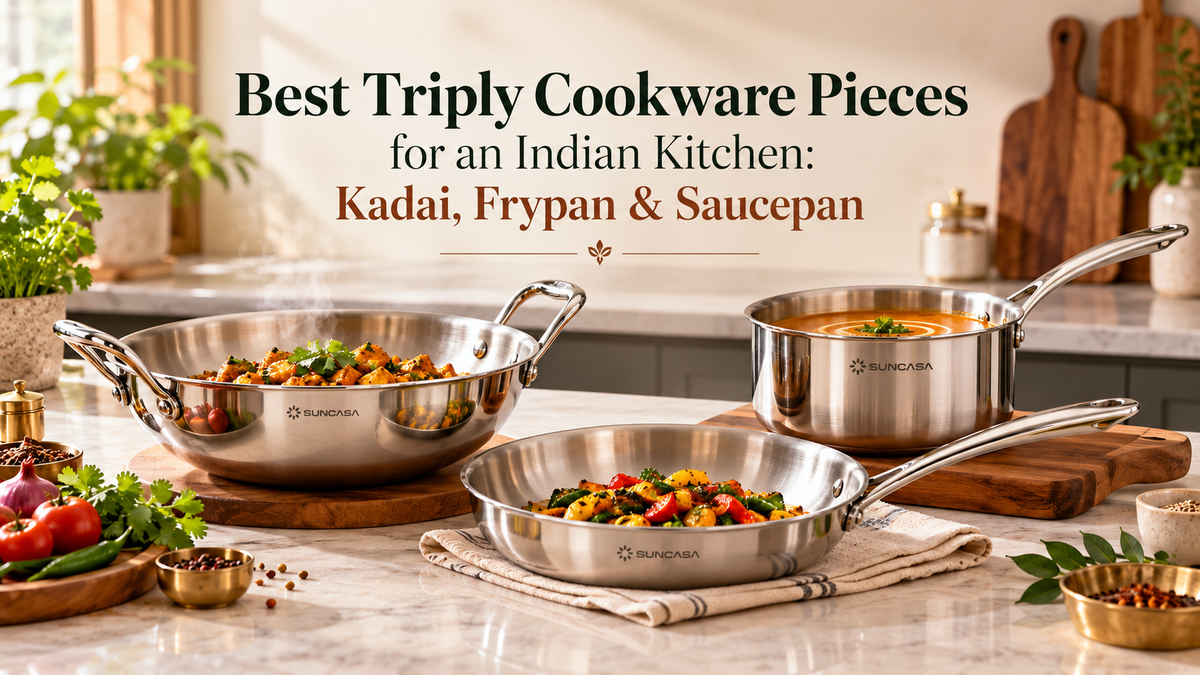
You do not need a cupboard full of cookware to handle everyday Indian meals. A small set of versatile pieces can handle most tasks if you choose each one for a clear purpose. For many homes, the core triply cookware for an Indian kitchen can be built around four workhorses: a kadai, frypan and saucepan.
The best piece is not the one with the most features. It is the one whose shape matches how you cook.
1. Triply Kadai: The Everyday All-Rounder
If you can buy only one deep pan, start with a triply kadai. Its rounded sides and depth make it useful for sautéing, simmering, frying and mixing ingredients without spilling.
-
Sabzi and dry vegetable preparations
-
Curries and gravies
-
Paneer dishes
-
Noodles and stir-fries
-
Shallow or deep frying, depending on kadai size
SUNCASA TRI-SMART kadais use three-layer construction with 304 stainless steel on the cooking surface, an aluminium core and magnetic stainless steel outside. For a household that cooks Indian food daily, this is often the most versatile starting point.
2. Triply Frypan: For Fast, Open-Pan Cooking
A frypan gives you a broad, relatively shallow surface. It is useful when evaporation, browning and easy access with a spatula are more important than depth.
-
Omelettes and egg dishes
-
Paneer or tofu searing
-
Shallow-fried cutlets
-
Stir-fried vegetables
-
Quick breakfasts and reheating with controlled browning
A triply frypan is especially useful for people who want stainless-steel durability but more predictable heating across the base and sides than a thin pan can provide.
4. Triply Saucepan: The Small Pan You Will Use Constantly
A saucepan often becomes the quiet workhorse of the kitchen. Its compact shape and long handle make it ideal for liquid-based tasks and smaller portions.
-
Tea and coffee preparations
-
Boiling milk
-
Soups and sauces
-
Small servings of dal or rasam
-
Pasta, noodles or reheating liquids
Triply construction is useful in a saucepan because milk, sauces and other liquids can scorch when heat is concentrated in one area. More even heating helps make temperature control easier.
Which Piece Should You Buy First?
|
Your cooking pattern |
Best first piece |
|
Mostly sabzis, curries and gravies |
Triply kadai |
|
Quick breakfasts, searing and shallow frying |
Triply frypan |
|
Tea, milk, soups and smaller liquid preparations |
Triply saucepan |
What Size Should You Choose?
Choose size based on your usual batch, not on the largest meal you might cook once a year. Smaller pans heat quickly and are easier to handle. Larger pans give you more room for family meals but occupy more storage space and can feel heavy when full.
Build a Four-Piece Core Instead of Buying Random Sets
A practical cookware set is one where each item has a distinct job. A kadai, frypan and saucepan cover different shapes and cooking techniques with minimal duplication. Once these essentials are in place, you can add a casserole, stockpot or specialty pan based on your own recipes.
Frequently Asked Questions
Which triply cookware piece is most useful for Indian cooking?
For many households, a kadai is the most versatile because it handles sautéing, curries, gravies and frying.
Do I need both a frypan and kadai?
They overlap slightly, but the frypan is better for open-pan browning and quick cooking, while the kadai gives more depth for gravies and mixed dishes.
What saucepan size should I buy?
Choose according to the amount of tea, milk, soup or sauce you usually prepare. A smaller saucepan is easier for daily portions.
Can triply cookware be used on induction?
Yes, if the outer layer or base is induction compatible. Check each product specification.
Conclusion
The best triply cookware for an Indian kitchen is not a huge matching set. It is a well-chosen group of shapes that covers the way you cook: kadai for depth and versatility, frypan for browning and saucepan for everyday liquids.
Shop SUNCASA triply cookware by product type


