

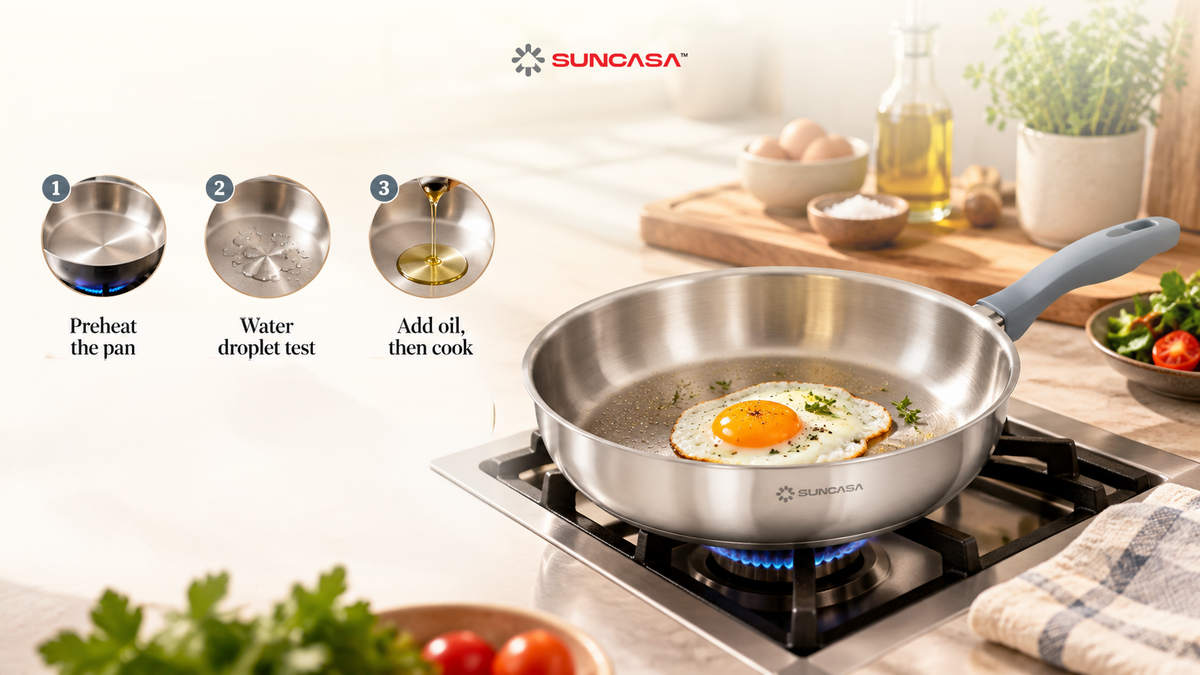
Stainless steel cookware is durable, versatile, and ideal for everyday cooking, but sticking can be frustrating. The good news is that you do not need a permanent coating to improve food release. With the right heat, oil, and cooking technique, you can learn how to make stainless steel non-stick for daily cooking.
Here’s how to do it effectively and use it with confidence.
Why Does Food Stick to Stainless Steel?
Unlike traditional non-stick cookware, stainless steel does not have a synthetic coating designed to prevent food from sticking to its surface. When the pan is too cold, food can get stuck to the metal and become difficult to release.
However, stainless steel can perform remarkably well when you control three things:
- Temperature: A properly preheated pan creates a better cooking surface.
- Oil: A thin layer of cooking oil helps create a barrier between the food and pan.
- Timing: Adding food at the right temperature and allowing it to cook undisturbed improves release.
This is why learning how to make stainless steel non-stick is less about permanently changing the cookware and more about understanding how it behaves during cooking.
The “Seasoning” Trick for Stainless Steel
Traditional seasoning involves repeatedly heating oil so that fats polymerise and create a durable layer, particularly on cast iron and carbon steel. Stainless steel is different. It does not retain this type of seasoning in the same way.
Instead, you can use a temporary oil-conditioning technique before cooking foods that tend to stick.
Follow these simple steps:
- Start with a clean, dry pan: Any moisture, food residue, or leftover oil can affect how evenly the pan heats. Wash and dry your cookware before starting.
- Preheat over medium heat: Place the pan on the cooktop and allow it to heat gradually. Avoid immediately adding oil or food to a cold pan.
- Check the temperature: Sprinkle a few drops of water into the pan. If they evaporate immediately, give the pan more time. When the droplets form small beads and glide across the surface, the pan is sufficiently hot.
- Lower or switch off the heat briefly: Add a small amount of cooking oil with a suitable smoke point, such as canola, grapeseed, or avocado oil.
- Spread a very thin layer: Use a paper towel or suitable heat-safe method to spread the oil evenly. You want a thin film rather than a pool of oil.
- Let the pan settle: Once the oil is distributed, you can begin cooking. The goal is not to create a permanent coating but to improve food release during that cooking session.
How to Make Stainless Steel Non-Stick While Cooking
The technique above works best when combined with good everyday cooking habits. For anyone wondering how to make stainless steel non-stick without using a coated pan, these small changes can make a significant difference.
|
Cooking habit |
Why it helps |
|
Preheat the pan |
Reduces the chances of food immediately sticking |
|
Use moderate heat |
Prevents excessive burning and uneven cooking |
|
Add enough oil |
Creates a cooking barrier |
|
Dry ingredients first |
Excess moisture can interfere with browning |
|
Avoid moving food too soon |
Allows a crust to develop naturally |
|
Use the correct utensil |
Helps release delicate foods without scraping |
For foods such as eggs, pancakes, fish, tofu, or cutlets, patience is especially important. Once the food develops a cooked surface, it often releases more easily from stainless steel.
Choosing Better Stainless Steel Cookware
Good technique matters, but cookware construction matters too. SUNCASA’s TRI-SMART Triply range combines three layers: 304 food-grade stainless steel, an aluminium core, and a 430 magnetic stainless steel exterior. This construction is designed to distribute heat evenly and support efficient cooking.
1. SUNCASA TRI-SMART Triply Frypan with Lid, 18cm
A frypan is particularly useful when cooking foods that require controlled heat and easy handling. The 18cm TRI-SMART Frypan has a 0.75L capacity and is suitable for omelettes, pancakes, cutlets, stir-fried vegetables, and shallow-fried snacks. Its stay-cool ergonomic handle also makes everyday cooking more comfortable.
2. SUNCASA TRI-SMART Triply Kadai with Lid, 18cm
For Indian everyday cooking, a kadai offers greater versatility. The 18cm TRI-SMART Kadai has a 1.3L capacity and is designed for sabzis, curries, dals, biryani, noodles, and other preparations. Its tempered glass lid makes it easier to monitor food while cooking.
Not just these two, but the entire TRI-SMART range is compatible with gas, induction, ceramic, and other compatible cooktops, making them practical choices for modern kitchens.
Daily Habits That Keep Food From Sticking
Getting nonstick stainless steel performance is not about using excessive oil. In fact, too much oil can create burnt residue and make cleaning harder.
Instead, follow a few simple habits:
- Always preheat before adding ingredients.
- Use medium to medium-low heat when appropriate.
- Pat vegetables, paneer, fish, or meat dry before cooking.
- Do not constantly move food around the pan.
- Use enough oil for the recipe rather than coating the entire pan heavily.
- Allow the pan to cool slightly before washing.
- Clean away burnt residue rather than allowing it to accumulate.
With consistent technique, stainless steel can become much easier to cook with.
When Should You Use This Technique?
This temporary conditioning method is particularly useful when preparing foods that are naturally prone to sticking.
|
Food |
Useful approach |
|
Eggs |
Preheat gently and use a thin oil layer |
|
Fish |
Dry the fish and avoid moving it too early |
|
Pancakes |
Maintain steady heat and use minimal oil |
|
Tofu |
Pat dry before placing in the pan |
|
Cutlets |
Let the outer surface cook before flipping |
|
Paneer |
Use moderate heat and avoid overcrowding |
For naturally fatty foods such as chicken thighs or steaks, you may not need to pre-condition the pan at all. Proper preheating, a little oil, and leaving the food undisturbed can already provide excellent results.
Clean It Normally After Cooking
One important point is that this is not permanent seasoning. You do not need to preserve the temporary oil film after every meal. Once cooking is complete, clean your stainless steel cookware normally using dish soap and water. If burnt oil or stubborn residue develops, clean it thoroughly before the next use. A clean cooking surface gives you a better starting point for the next preheating cycle.
Enjoy Easier Everyday Cooking
Learning how to make stainless steel non-stick is really about mastering heat, oil, timing, and patience rather than creating a permanent coating. With the right technique and well-constructed cookware such as SUNCASA TRI-SMART Triply, everyday cooking can become easier, cleaner, and more enjoyable.
Explore the complete SUNCASA cookware collection and shop directly from the official store today.
FAQs
Can SUNCASA TRI-SMART cookware be made temporarily non-stick?
Yes. Preheating the pan, using a thin layer of oil, and allowing food to cook undisturbed can improve food release. TRI-SMART’s even heat distribution also supports better temperature control.
Why does food sometimes stick to SUNCASA stainless steel cookware?
Sticking usually happens when the pan is not properly preheated, there is insufficient oil, or food is moved too early. Using moderate heat and allowing food to form a cooked surface can help.
Is SUNCASA TRI-SMART cookware permanently non-stick?
No. TRI-SMART is stainless steel cookware, not cookware with a synthetic non-stick coating. Its three-layer construction supports even heating, while proper cooking technique helps improve food release.
Which SUNCASA TRI-SMART cookware is useful for everyday cooking?
The TRI-SMART Frypan works well for omelettes, pancakes, and cutlets, while the TRI-SMART Kadai is suited to sabzis, curries, dals, biryani, and other everyday Indian dishes.
How should I clean SUNCASA TRI-SMART cookware after cooking?
Clean the cookware normally with dish soap and water after use. If food or oil residue is burnt onto the surface, clean it thoroughly before the next cooking session for a fresh start.


