

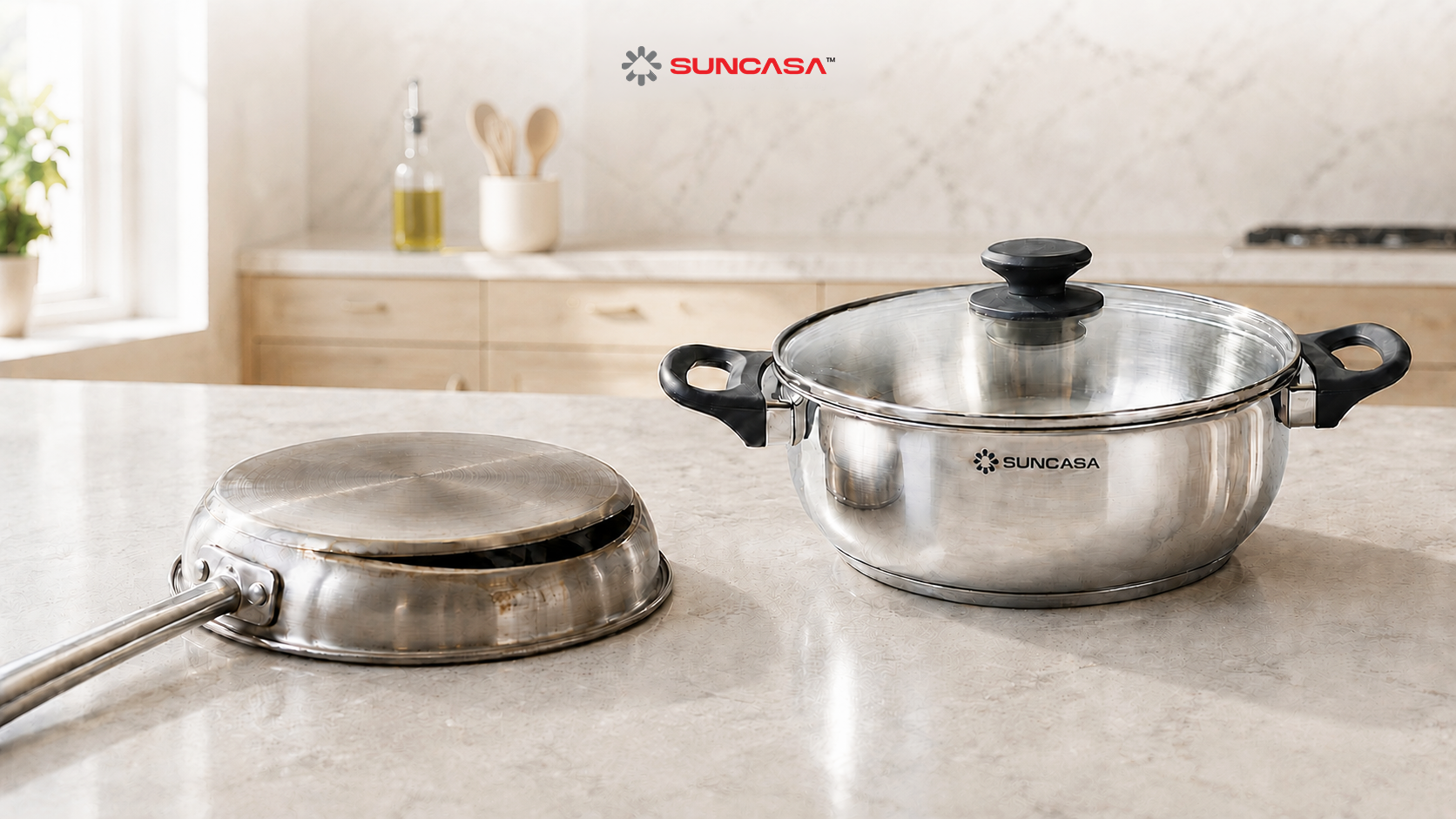
If you've ever noticed the base of a pan bulging, separating, or making unusual sounds after months of use, you're not alone. One of the most common reasons is the way the bottom of the cookware has been constructed. When choosing between an impact bottom and a sandwich bottom, many buyers focus only on how the heat is distributed or the price. However, how it was manufactured also affects the cookware’s durability and determines whether the base stays firmly attached after years of cooking.
Let's understand why the pan base matters and how choosing the right construction can help you avoid problems in the long run.
Why Does a Pan's Bottom Matter?
The base of any stainless steel pan performs two important jobs. First, it absorbs heat from the stove and distributes it evenly to the cooking surface. Second, it must remain stable despite being exposed to repeated heating and cooling every day.
If the base is poorly constructed, it may eventually:
- Warp due to repeated heating
- Develop uneven heating
- Separate from the pan body
- Produce a rattling or hollow sound
- Lose cooking efficiency
This is why the question isn't simply about the impact bottom or sandwich bottom, but rather it’s about how the base has actually been manufactured.
Why Some Pan Bases Come Off
One of the biggest concerns people have with stainless steel cookware is seeing the bottom separate after years of cooking. This usually happens because cookware experiences constant thermal expansion.
Every time you cook:
- The base heats up.
- The metal expands.
- The pan cools.
- The metal contracts again.
This cycle repeats thousands of times throughout the life of the cookware. If the bond between the layers isn't strong enough, these repeated expansion and contraction cycles can gradually weaken the joint, eventually causing the base to separate. This is exactly why manufacturing quality matters far more than appearance alone.
Comparing Sandwich and Impact Bottom Construction
How a Sandwich Bottom is Constructed
A sandwich bottom pan is made by placing an aluminium layer between two stainless steel layers at the base of the cookware. The aluminium helps improve heat distribution, while the outer stainless steel layer makes the cookware compatible with different cooktops.
When manufactured well, sandwich-bottom cookware offers:
- Better heat distribution than single-layer stainless steel
- Good heat retention
- Compatibility with gas and induction cooktops
However, the durability of the base depends heavily on how these layers are bonded together. If the bonding process is not strong enough, repeated heating and cooling gradually weaken the joint, increasing the chances of the base coming loose over time.
What Is Impact Forged Construction?
An impact bottom pan uses a different manufacturing process altogether. Instead of simply attaching multiple layers, a thick aluminium core is fused to the stainless steel base using extremely high pressure during manufacturing.
In premium cookwares such as the SUNCASA's Impact Pro range, this process uses approximately 1600–2500 tons of pressure to create a seamless and durable bond. This process is known as impact forging or impact bonding. Because the aluminium disc is permanently fused to the base under immense pressure, the bond becomes exceptionally strong, making it nearly impossible to come apart due to everyday use.
Why Impact Forged Construction Is More Reliable
To elaborate on the point, a high-quality impact bottom is designed specifically to withstand years of thermal stress. Since the aluminium core is permanently fused under very high pressure, the base behaves as a single integrated unit rather than separate pieces joined together.
This provides several advantages:
- Stronger bond between materials
- Better resistance to repeated heating cycles
- Reduced the chances of the base separating
- Excellent structural stability
- Longer cookware life
So instead of worrying about the bottom loosening over time, you can cook confidently knowing the base is designed for everyday use.
Better Heat Distribution Without Compromising Durability
A common misconception is that durability comes at the cost of cooking performance. In reality, impact-forged cookware delivers both. The thick aluminium core spreads heat evenly across the cooking surface, helping reduce hotspots and preventing food from burning.
At the same time, the forged construction keeps the base firmly attached even after years of regular cooking. Whether you're making tea, preparing curries, boiling milk, cooking rice, or sautéing vegetables, an impact-forged base provides consistent cooking performance.
Material Quality Is Equally Important
The base of a pan is undoubtedly the foundation for any good cookware, but the stainless steel body also plays a vital role. The SUNCASA's Impact Pro cookware is made from 304 food-grade stainless steel, which is:
- Non-reactive with acidic ingredients
- Rust and corrosion resistant
- Hygienic for everyday cooking
- Durable enough for years of use
- Easy to clean and maintain
When combined with impact-forged construction, the result is cookware that is both safe and built for long-term performance.
How SUNCASA Uses Impact Forged Technology
SUNCASA has built its Impact Pro collection around durability as much as cooking performance.
Hence, instead of just simply relying on layered construction, the cookware uses an impact-forged base created under high pressure to produce a seamless bond between stainless steel and the aluminium core. The range also features 304 food-grade stainless steel, stay-cool handles, compatibility with gas and induction cooktops, and easy maintenance, making it suitable for everyday Indian cooking.
Impact Bottom or Sandwich Bottom: Which Should You Choose?
If you're comparing an impact bottom or sandwich bottom, the decision shouldn't be based only on heat distribution.
Instead, ask:
- How strong is the bond between the layers?
- Will the base stay intact after years of use?
- Is the cookware made with food-safe stainless steel?
- Has it been engineered for long-term durability?
A well-manufactured impact bottom answers all these questions with confidence.
Invest in Dependable Everyday Cooking
When a pan's bottom comes off, the problem usually isn't stainless steel, it's the quality of the construction. While both sandwich-bottom and impact-base cookware can provide even heating, impact-forged construction creates a much stronger bond between the base and the pan, helping prevent separation caused by repeated heating and cooling.
Combined with 304 food-grade stainless steel, it offers dependable performance, lasting durability, and peace of mind. That's why investing in cookware with a well-engineered impact bottom is one of the smartest choices for a kitchen that cooks every day.
FAQs
What is the difference between an impact bottom and a sandwich bottom cookware?
Impact bottom cookware uses high-pressure forging to permanently fuse the aluminium core with the stainless steel base, creating a stronger bond. SUNCASA Impact Pro cookware combines this technology with 304 food-grade stainless steel for durability and even heat distribution.
Why does the base of some stainless steel pans separate over time?
The base can separate due to repeated heating and cooling if the bond between the layers is weak. SUNCASA's impact-forged construction uses immense pressure to create a seamless, long-lasting bond that resists everyday thermal stress.
Is impact bottom cookware suitable for daily Indian cooking?
Yes. SUNCASA Impact Pro cookware is designed for everyday Indian cooking, from boiling milk and making curries to sautéing vegetables. Its impact-forged base ensures even heating, while the 304 stainless steel body offers strength and food safety.
How does SUNCASA's impact-forged technology improve cookware durability?
SUNCASA uses impact forging under approximately 1600–2500 tons of pressure to securely fuse the aluminium core with the stainless steel base. This manufacturing process enhances structural stability and helps prevent the base from loosening over the years of regular use.
Why should I choose SUNCASA Impact Pro cookware over conventional stainless steel cookware?
SUNCASA Impact Pro cookware combines an impact-forged heavy bottom, 304 food-grade stainless steel, stay-cool handles, and compatibility with gas and induction cooktops. This combination delivers reliable heat distribution, long-term durability, and dependable everyday cooking performance.


