

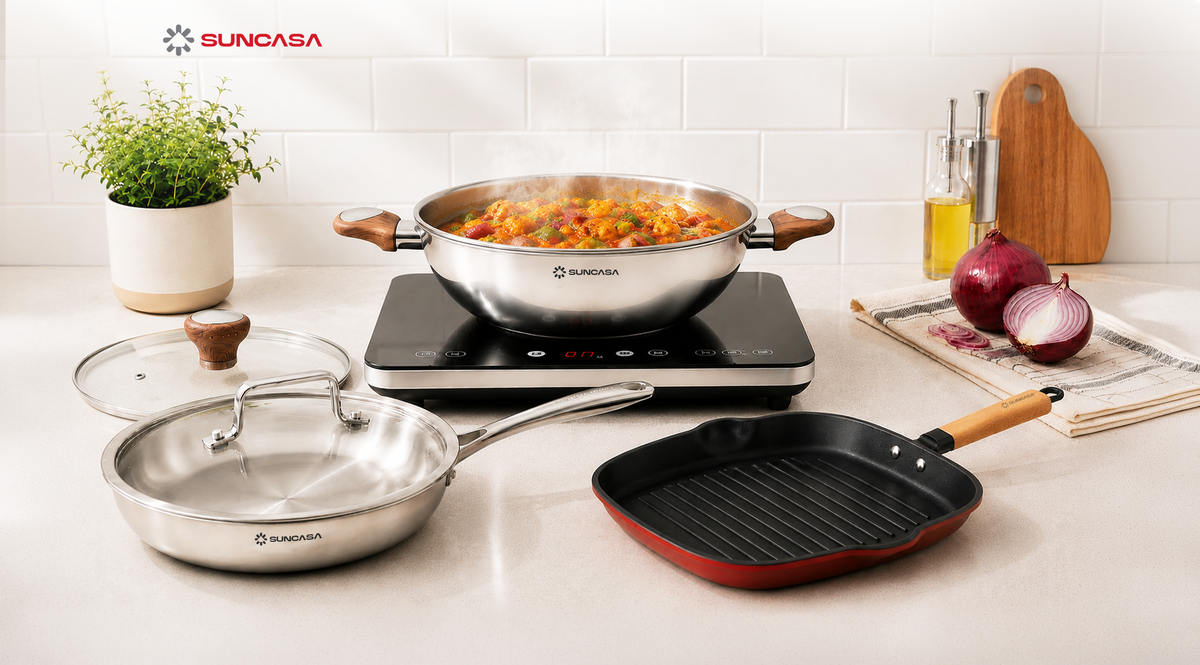
Induction cooktops are quick and energy-efficient, which is the reason why they’re becoming a regular feature in many Indian kitchens. But unlike gas stoves, they cannot heat every type of cookware. They work using magnetic energy, so the cookware’s material and base make a big difference.
If you’ve ever wondered what not to use on an induction cooktop, the simple rule is this: your cookware needs a magnetic, flat base to heat properly. Knowing this can save you from uneven cooking, wasted time, and buying cookware that isn’t compatible.
How Does an Induction Cooktop Work?
An induction cooktop uses an electromagnetic field to generate heat in compatible cookware. Unlike gas, where the flame heats the bottom of the pan, induction transfers heat directly into the cookware.
This means:
- Magnetic cookware is essential: The base needs magnetic properties so the electromagnetic field can generate heat effectively.
- The base matters: A flat, properly constructed base helps maintain good contact with the cooking surface and supports more consistent heating.
- Material alone is not enough: Stainless steel cookware may or may not work on induction, depending on its construction and whether it includes a suitable magnetic base.
Which Cookware Will Not Work on Induction?
Knowing which cookware cannot be used on an induction stove is particularly useful when buying new pans or moving from gas cooking to induction.
1. Traditional Aluminium Cookware
Aluminium is an excellent heat conductor, but ordinary aluminium does not have the magnetic properties required for induction cooking.
- Regular aluminium pans: These generally will not heat on induction unless they have been designed with a compatible magnetic base.
- What to check: Look for an induction-compatible base rather than assuming that every aluminium pan will work.
- Why it matters: Placing incompatible aluminium cookware on an induction cooktop will generally result in little or no heating.
2. Glass and Ceramic Cookware
Glass and ceramic cookware are not naturally magnetic, so traditional versions cannot interact with an induction cooktop.
- Regular glass cookware: It will not generate heat through the electromagnetic field used by induction.
- Ceramic cookware: Traditional ceramic vessels are similarly unsuitable unless they incorporate a magnetic base.
- Coated cookware: A ceramic or non-stick coating does not automatically make cookware induction-compatible; the base underneath must support induction cooking.
3. Traditional Copper Cookware
Copper is valued for its excellent heat conductivity, but traditional copper cookware is not magnetic.
- Pure copper pans: These generally cannot activate an induction cooktop.
- Specially designed versions: Copper cookware can work if manufacturers incorporate a compatible magnetic layer into the base.
- What to remember: The presence of copper does not determine compatibility; the cookware's magnetic base does.
4. Some Stainless Steel Cookware
Stainless steel is where things can become confusing. Not every stainless-steel pan works on induction.
- Non-magnetic stainless steel: Certain stainless-steel formulations are not magnetic and therefore cannot interact effectively with induction technology.
- Magnetic stainless steel: Cookware made with a suitable magnetic base can work efficiently on induction.
- The simple test: Place a magnet against the bottom of the pan. If it sticks firmly, the cookware is generally suitable for induction.
5. Warped or Uneven Cookware
Even if a pan is technically induction-compatible, its physical condition can affect how well it performs.
- Warped bottoms: A distorted base may not sit properly against the cooktop, affecting heating efficiency.
- Uneven contact: Poor contact can make heat distribution less consistent and may cause the cookware to move while cooking.
- Flat bases are preferable: Choose cookware with a well-constructed base designed for stable contact with the cooktop.
How Can You Check Your Cookware?
Before replacing your existing cookware, you can perform a simple test at home.
Try the Magnet Test
Place a magnet against the bottom of your cookware.
- Magnet sticks firmly: The cookware is likely to have the magnetic properties needed for induction.
- Magnet does not stick: The cookware is unlikely to work directly on an induction cooktop.
SUNCASA Cookware: Designed for Different Cooktops
Choosing cookware that works across different cooktops makes everyday cooking easier. You can switch from gas to induction without having to replace your entire cookware collection. SUNCASA offers three versatile ranges designed to work with induction and other cooking formats:
- TRI-SMART: Triply cookware designed for even heating and everyday cooking.
- IMPACT PRO: Impact-forged stainless steel cookware built for durability and regular use.
- CASTELLA: Enamel-coated cast iron cookware (Pre-seasoned) made for high-heat cooking.
TRI-SMART Triply Cookware
TRI-SMART combines 304-grade food-grade stainless steel with a layered construction designed for even heat distribution.
- All-cooktop compatibility: The range works with gas, induction, ceramic, and oven cooking.
- Even heating: Its triply construction helps distribute heat more consistently across the cookware.
- Stay-cool handles: The handles are designed to make everyday handling more comfortable.
- Practical design: Features such as a drip-free rim and stainless-steel cap rivets support easier pouring and long-term handle durability.
IMPACT PRO Cookware
The IMPACT PRO collection uses SUNCASA's impact-forged bottom technology, which fuses stainless steel with an aluminium core to create a durable cooking base.
- Induction compatible: The impact-forged base is designed to work across different heat sources, including induction.
- Even heat distribution: The aluminium core helps spread heat efficiently across the base.
- 304 stainless steel: The cookware uses food-grade stainless steel for a durable cooking surface.
- Long-term construction: The seamless impact-bonded base is designed for regular cooking and better heat retention.
CASTELLA Cast Iron Cookware
CASTELLA takes a different approach by using pre-seasoned cast iron with an enamel-coated exterior.
- Induction compatible: Cast iron's magnetic properties make it naturally suitable for induction cooking.
- High heat retention: Its heavy construction holds heat well, making it useful for searing, grilling, and slow cooking.
- Versatile cooking: SUNCASA's CASTELLA range includes grill pans, tawas, and kadhais, giving you options for different recipes.
- Pre-seasoned surface: The cookware is supplied pre-seasoned, helping create a naturally non-stick cooking surface.
Why Cooktop Compatibility Matters
Choosing induction-compatible cookware is not only about getting your pan to heat. It is also about having cookware that fits your wider cooking routine.
- More flexibility: All-cooktop cookware can move between induction, gas, and ceramic setups without requiring a completely new collection.
- Better long-term value: Cookware that supports multiple cooking formats can remain useful even if your kitchen setup changes.
- Simpler shopping: You can focus on construction, size, and cooking performance instead of buying separate pans for every cooktop.
SUNCASA's cookware range reflects this approach, with its stainless-steel and cast-iron collections designed around compatibility with different heat sources.
What Should You Check Before Buying?
If you are specifically shopping for induction cookware, keep these points in mind:
- Check the base: Look for clear induction compatibility rather than relying only on the cookware's outer material.
- Use the magnet test: A firmly sticking magnet is a useful first check for magnetic compatibility.
- Look for a flat bottom: A stable, properly constructed base supports better contact and more consistent heating.
- Consider other cooktops: If you also use gas or ceramic cooking, choosing all-cooktop cookware gives you greater flexibility.
The Bottom Line
So, what not to use on an induction cooktop? Traditional aluminium, copper, glass, ceramic, non-magnetic stainless steel, and severely warped cookware generally cannot be used effectively without a suitable induction-compatible base.
Ultimately, knowing which cookware cannot be used on an induction stove helps you make a smarter choice. Look beyond the material name while selecting among the best induction cookware; check the base, construction, cooktop compatibility, and everyday cooking requirements before bringing a new pan into your kitchen.
The good news is that you do not have to limit yourself to one material. SUNCASA's TRI-SMART, IMPACT PRO, and CASTELLA ranges are designed for induction as well as other cooking formats, combining compatibility with features suited to different cooking styles.
FAQs
Does all stainless steel cookware work on induction cooktops?
No. Stainless steel is not always magnetic. SUNCASA's TRI-SMART and IMPACT PRO ranges are induction-compatible, making them suitable for modern kitchens and multiple cooking formats.
Can SUNCASA cookware be used on gas and induction?
Yes. SUNCASA's TRI-SMART, IMPACT PRO, and CASTELLA ranges are compatible with induction and other cooking formats, including gas and ceramic, offering greater flexibility.
Why does aluminium cookware not work on induction?
Traditional aluminium is not magnetic and therefore cannot interact with an induction cooktop. Cookware needs a suitable magnetic base to heat effectively on induction cooking surfaces.
Is SUNCASA TRI-SMART suitable for induction cooking?
Yes. SUNCASA TRI-SMART cookware is induction-compatible and also works with gas, ceramic, and oven cooking, while offering 304-grade stainless steel and even heat distribution.
How can I check whether cookware works on induction?
Place a magnet against the cookware's base. If it sticks firmly, the cookware is generally magnetic and likely suitable for induction, although manufacturer specifications should always be checked.


