

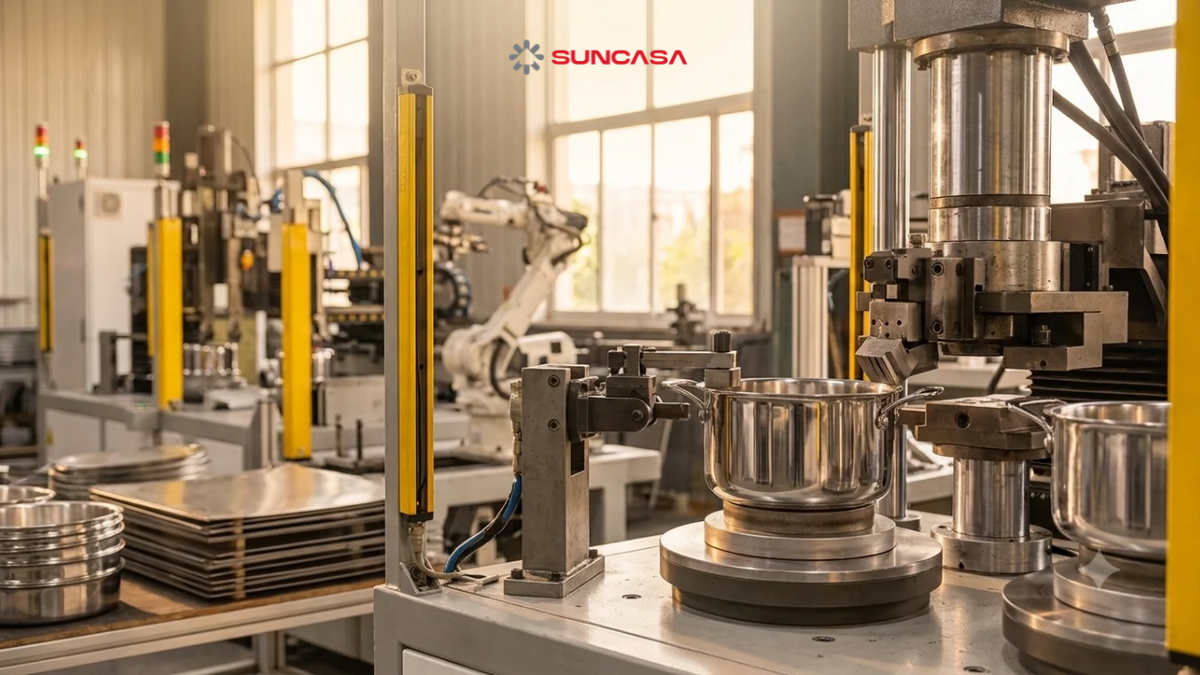
A premium cookware piece is more than polished steel. It is the result of careful material selection, precise forming, layered construction, finishing, and quality checks. Which is why, for all home cooks and first-time kitchen explorers, it’s important to know how stainless steel utensils are made, which will help them understand their construction. How’s that going to be useful in the long run? Simple: this knowledge will always let you choose the right and the most premium stainless steel utensil each time you decide to purchase.
From Sheet Metal to Cookware: The Manufacturing Journey
Premium stainless steel cookware begins long before it reaches the kitchen. Each stage of production affects the final product’s strength, shape, finish, and cooking performance.
1. Selecting the Right Stainless Steel
The first step in understanding how stainless steel utensils are made is understanding the material. Stainless steel used for cookware is selected according to its grade, composition, purity, and intended use. We use 304 food-grade stainless steel in our cookware, because of its unmatched durability and suitability for everyday cooking.
2. Cutting and Preparing the Metal
Large stainless steel sheets are cut into precise pieces according to the size and design of the cookware. Accurate preparation ensures that the material is ready for the next manufacturing stages. After cutting, edges can be ground and smoothed to remove rough sections and burrs. This creates cleaner edges and helps the material move smoothly into the shaping process.
3. Shaping the Cookware
The flat stainless steel pieces are shaped using controlled pressure and forming techniques. In cookware manufacturing, deep drawing or similar forming processes can transform flat sheets into the familiar shape of a kadai, saucepan, frypan, or casserole. The process requires accurate control because the cookware needs to retain its intended shape and dimensions.
4. Building the Triply Layers
This is where premium stainless steel variants like triply cookware get their unique advantage. SUNCASA’s stainless steel cookware, such as the TRI-SMART range, uses a three-layer construction comprising 304 food-grade stainless steel, an aluminium core, and 430 magnetic stainless steel on the exterior. The aluminium layer helps distribute heat, while the stainless steel layers provide durability and cooktop compatibility.
|
TRI-SMART Layer |
Purpose |
|
304 stainless steel |
Food-grade cooking surface and durability |
|
Aluminium core |
Helps spread heat more evenly |
|
430 magnetic stainless steel |
Supports induction compatibility |
This layered structure is central to understanding how stainless steel utensils are made when the goal is not simply to create a vessel, but to create cookware that performs consistently.
5. Forming Functional Details
Once the main body is formed, details such as handle points, rims, and other components are prepared. Holes can be punched where required for handle attachment, while edges are trimmed and deburred to achieve the intended dimensions and a safer finish.
6. Adding Strong, Comfortable Handles
A cookware handle has to do more than look good. It needs to stay securely attached through repeated lifting, stirring, washing, and everyday use. Handles may be welded or riveted during manufacturing, with alignment and joint strength checked carefully. TRI-SMART combines stay-cool handles with stainless steel cap rivets. The handle design makes handling more comfortable, while the cap rivets provide a sturdy, long-lasting connection.
7. Finishing and Polishing
After shaping and assembly, cookware goes through finishing operations. Polishing uses progressively finer abrasives to create a smooth, clean surface and the familiar stainless steel appearance. A well-finished surface also makes the cookware easier to maintain and contributes to its overall appearance.
8. Quality Inspection Before Packing
Before cookware reaches a customer, it gets checked for consistency and defects. A thorough inspection includes stages that involve visual checks, dimensional measurements, thickness and weight checks, and durability testing.
What Makes Premium Cookware Different?
The manufacturing process becomes meaningful when each stage works towards a practical kitchen benefit. Here is how the construction translates into everyday use:
|
Manufacturing or Design Feature |
Everyday Benefit |
|
304-grade stainless steel |
Durable, food-grade cooking surface |
|
Triply construction |
More even heat distribution |
|
Aluminium core |
Helps transfer heat efficiently |
|
430 magnetic stainless steel |
Supports induction compatibility |
|
Stay-cool handle |
More comfortable handling |
|
Drip-free rim |
Cleaner, controlled pouring |
|
Stainless steel cap rivets |
Sturdy, durable handle connection |
|
Easy-to-clean construction |
Simpler everyday maintenance |
Why Construction Matters More Than Just Appearance
A shiny finish may be the first thing noticed, but the real value of cookware lies beneath the surface. The material grade, layer construction, forming accuracy, handle attachment, and finishing all contribute to how the cookware performs over time.
Premium construction is not one single feature. It is the combination of several carefully executed stages that creates a reliable cooking tool.
For SUNCASA, that approach brings together 304-grade stainless steel, impact forged construction, even heat distribution, stay-cool handles, a drip-free rim, sturdy stainless steel cap rivets, easy cleaning, and compatibility with gas, ceramic, oven, and induction cooktops.
From Manufacturing to Everyday Cooking
When you understand how stainless steel utensils are made, a premium saucepan or kadai starts to look different. What appears to be a simple kitchen utensil is actually the result of material selection, precision forming, layered construction, finishing, and quality checks. SUNCASA TRI-SMART applies these principles to create cookware designed for everyday Indian kitchens, combining practical details with durable construction for consistent performance across different everyday cooking tasks.
Explore SUNCASA cookware collection on our online store today.
FAQs
How is SUNCASA stainless steel cookware made?
SUNCASA stainless steel cookware begins with suitable food-grade raw materials selected for durability and kitchen use. The manufacturing process then involves shaping, trimming, finishing, adding handles, polishing, and quality checks to create cookware designed for reliable everyday performance and quality.
How is stainless steel shaped into cookware?
Stainless steel is shaped into cookware through processes such as cutting, forming, deep drawing, trimming, and finishing. SUNCASA’s manufacturing approach focuses on consistent construction and quality checks, helping turn carefully selected stainless steel into practical cookware for everyday kitchens.
Why are quality checks important during cookware manufacturing?
Quality checks are important because they help identify issues with shape, finish, construction, handles, and overall workmanship. SUNCASA’s cookware manufacturing process includes inspection before packing, helping ensure products meet expected standards for everyday kitchen use and durability for consistency checks.
Why is stainless steel cookware polished?
Polishing gives stainless steel cookware a smoother, cleaner-looking finish while also supporting easier maintenance. In SUNCASA’s manufacturing process, finishing follows shaping and other production steps, helping create cookware that combines practical performance with a neat appearance for busy Indian kitchens.
Why does SUNCASA use food-grade stainless steel?
SUNCASA uses food-grade stainless steel in its cookware range because the material is valued for strength, durability, and resistance to corrosion. The manufacturing process combines material selection, shaping, finishing, assembly, and quality inspection to create dependable kitchen products for homes.


