

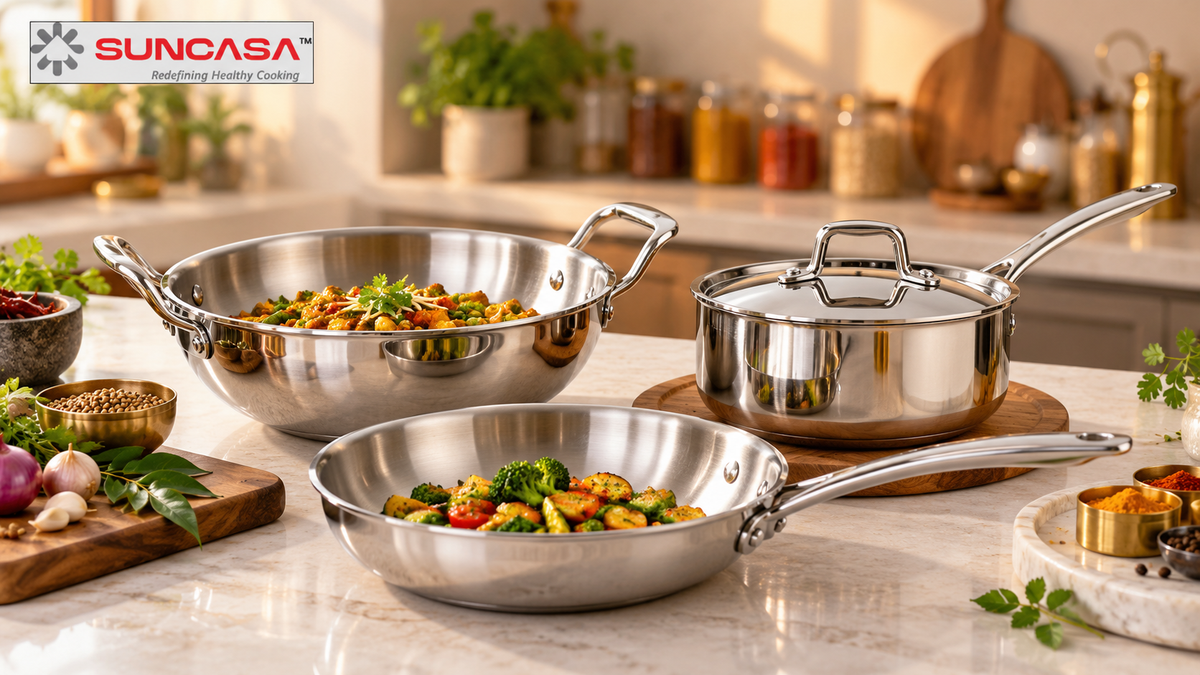
Walk into a cookware store today and you will probably see the word “triply” on everything from kadais and frypans to saucepans and tawas.
But what exactly does triply mean?
Is it simply thicker stainless steel? Does it cook differently? And is triply cookware actually useful for everyday Indian cooking?
The answer lies inside the cookware itself.
Triply cookware is made by permanently bonding three different metal layers together so that each material can perform the job it does best. Stainless steel provides a durable cooking surface, aluminium helps distribute heat quickly, and the exterior layer adds strength and compatibility with different cooktops.
This combination is what makes triply stainless steel cookware different from conventional single-layer cookware.
In this guide, we explain how triply cookware works, what the three layers actually do, where it performs best, and what you should check before choosing triply cookware for your kitchen.
What Is Triply Cookware?
The word “triply” simply means three layers.
Instead of constructing a pan, kadai or saucepan from one sheet of metal, triply cookware combines three metal layers into a single cookware body.
A typical triply construction consists of:
|
Layer |
Material |
Main Purpose |
|
Inner cooking layer |
Food-grade stainless steel |
Provides a durable, non-reactive cooking surface |
|
Middle layer |
Aluminium |
Conducts and distributes heat efficiently |
|
Outer layer |
Magnetic stainless steel |
Adds durability and enables induction compatibility |
The important difference is that these layers generally run through the entire body of the cookware, including the base and side walls.
That full-body construction is one of the reasons triply utensils can distribute heat more consistently than cookware where a conductive layer is present only at the bottom.

How Does Triply Cookware Work?
To understand why triply cookware behaves differently, it helps to understand the metals involved.
Stainless steel is durable, hygienic and suitable for cooking a wide variety of foods. However, stainless steel by itself is not an exceptionally fast conductor of heat.
Aluminium conducts heat much more efficiently.
Triply cookware combines these characteristics.
When your burner heats the bottom of the vessel, the aluminium layer helps transfer that heat across the cooking surface and towards the side walls. The stainless-steel layers protect the aluminium core while providing the strength, finish and cooking surface needed for daily use.
Instead of one material being expected to do everything, the three-layer construction allows different metals to work together.
This is the basic principle behind triply stainless steel cookware.
Understanding the Three Layers of Triply Cookware
1. The Inner Stainless-Steel Layer
The innermost layer is the surface that comes directly in contact with your food.
High-quality triply cookware commonly uses food-grade stainless steel for this layer because it is durable and suitable for preparing a wide range of dishes.
This makes the cooking surface suitable for everything from dal, vegetables and curries to tomato-based gravies, rasam and other everyday foods.
In SUNCASA TRI-SMART cookware, the inner cooking surface is made using food-grade stainless steel.
2. The Aluminium Core
The centre layer is where much of the heat-distribution advantage comes from.
Aluminium reacts to temperature changes more quickly than stainless steel and conducts heat efficiently.
When placed between stainless-steel layers, it helps spread heat across the vessel rather than allowing heat to remain concentrated only at the point directly above the flame or heating element.
This can give the cook greater control when sautéing, simmering or preparing foods that benefit from steady heat.
3. The Outer Stainless-Steel Layer
The third layer forms the exterior of the utensil.
A magnetic stainless-steel exterior can make the cookware suitable for induction while also protecting the aluminium core.
This allows well-designed triply cookware to work across modern Indian kitchens using gas, induction and other compatible cooktops.
Why Does Even Heat Distribution Matter?
You may wonder whether heat distribution really makes a noticeable difference while cooking.
It often can.
Imagine preparing a thick gravy in a kadai. If one area of the base becomes much hotter than the rest, ingredients near that point can begin browning or sticking while ingredients elsewhere are still cooking slowly.
A vessel that distributes heat more uniformly makes temperature management easier.
This becomes especially useful for recipes involving sautéing masalas, reducing sauces, slow-cooking gravies, roasting ingredients, shallow frying or preparing dishes that require controlled heating for longer periods.
Triply construction does not eliminate the need to manage your flame, but it can make the cookware respond more predictably.
Triply Cookware vs Regular Stainless-Steel Cookware
Regular stainless-steel cookware and triply stainless-steel cookware can look very similar from the outside.
Their construction, however, can be quite different.
|
Feature |
Regular Single-Layer Stainless Steel |
Triply Stainless Steel Cookware |
|
Construction |
Usually one main metal layer |
Three bonded layers |
|
Heat distribution |
Depends heavily on construction |
Designed for more even heat spread |
|
Aluminium core |
Usually absent from full body |
Present between steel layers |
|
Side-wall heating |
Can be limited |
Heat can spread through sides as well |
|
Temperature control |
Depends on thickness/design |
Generally more responsive |
|
Induction compatibility |
Model dependent |
Usually available with magnetic exterior |
|
Weight |
Often lighter |
Usually moderately heavier |
|
Price |
Generally lower |
Generally higher due to construction |
This does not mean ordinary stainless-steel cookware is unsuitable for cooking.
Different constructions suit different cooking needs.
The advantage of triply cookware becomes more noticeable when you want better heat management across the complete cooking surface.
Triply Cookware vs Impact-Bottom Cookware
This is another common source of confusion.
Both constructions may combine stainless steel and aluminium, but the location of those layers differs.
In impact-bottom cookware, the additional conductive layers are primarily concentrated at the base.
In triply cookware, the layered construction generally extends through the body of the vessel.
Impact-bottom cookware can therefore be an excellent option for daily cooking tasks where efficient base heating is most important, while triply cookware can be particularly useful when more uniform heating through both the base and sides is desirable.
The right choice depends on how you cook.
Impact Bottom vs Triply Cookware – What’s the Difference?
What Are the Benefits of Triply Cookware?
The biggest advantage is not simply that triply cookware has “three layers.” What matters is what those layers allow the cookware to do.
A well-made triply vessel can provide more balanced heating across the cooking surface, better temperature control, a durable stainless-steel food-contact surface, compatibility with modern cooktops and the versatility needed for different cooking techniques.
For Indian kitchens, that versatility is particularly useful because the same cookware may be used for frying onions, roasting spices, simmering gravies, cooking vegetables and finishing dishes at lower heat.
You are not buying three layers simply for the sake of having three layers. You are buying a construction designed to combine durability with more effective heat management.
Is Triply Cookware Good for Indian Cooking?
Yes. In fact, Indian cooking is one of the situations where triply construction can be especially practical.
Many Indian recipes require several temperature stages.
You may begin by heating oil, followed by tempering whole spices, sautéing onions, adding tomatoes and masalas, and then simmering the finished gravy.
A cookware material that distributes heat consistently can make these transitions easier to control.
Triply kadais are particularly useful for curries, sabzis, biryanis and sautéing.
Triply frypans work well for shallow frying, cutlets, omelettes, vegetables and similar preparations.
Triply saucepans can be used for milk, tea, sauces, soups and smaller portions.
Triply tawas can provide a broad, consistently heated surface for recipes where uniform contact with the pan matters.
Does Triply Cookware Need High Heat?
Usually, no.
Because the aluminium core transfers heat efficiently, continuously cooking at maximum flame is often unnecessary.
For many recipes, preheating the cookware gradually and then using medium or low-to-medium heat can provide good results.
Learning to control heat is particularly important with stainless-steel cookware.
For example, when shallow frying or cooking foods that tend to stick, allow the pan to warm gradually before adding oil and ingredients. Avoid overheating an empty vessel for long periods.
Proper temperature control improves cooking results and can also make cleaning easier.
How to Make Stainless Steel Cookware Naturally Non-Stick
Is Triply Stainless Steel Cookware Non-Stick?
Triply stainless steel and chemically coated non-stick cookware are different products.
An uncoated triply stainless-steel pan does not depend on a synthetic non-stick coating.
Food release instead depends largely on cooking technique, temperature and the amount of oil being used.
Once you learn how to preheat stainless steel correctly and allow food to develop a cooked surface before turning it, many everyday foods can be prepared comfortably.
This also means you do not need to treat the cooking surface in exactly the same way as a delicate non-stick coating.
Is Triply Cookware Induction Friendly?
Triply cookware can be induction compatible when its outer layer contains magnetic stainless steel.
Induction cooktops work by interacting with magnetic material in the base of the vessel.
Therefore, do not assume that every three-layer utensil automatically works on induction. Always check the manufacturer's specifications.
SUNCASA's triply range uses a magnetic stainless-steel exterior designed for compatible induction cooking.
Is Triply Cookware Heavy?
Triply cookware will generally feel more substantial than thin single-layer cookware because three bonded layers are being used.
However, triply cookware does not need to be excessively heavy to perform well.
The ideal balance is cookware that feels sturdy enough for stable cooking while remaining practical enough to lift, pour, wash and use regularly.
When choosing a kadai, saucepan or frypan, consider both construction and the size of the vessel.
A very large vessel filled with food will naturally become heavier regardless of the cookware technology.
How to Choose Good Triply Cookware
Do not judge triply cookware only by appearance.
Check what materials are used in all three layers, whether the inner surface is food-grade stainless steel, whether the exterior supports your cooktop, how securely the handles are attached, and whether the size matches your cooking requirements.
Also consider whether the manufacturer clearly explains the construction.
The term “triply” should describe a genuine three-layer bonded construction rather than simply being used as a marketing label.
SUNCASA Triply Cookware Collection
SUNCASA TRI-SMART Triply Cookware
SUNCASA's TRI-SMART range is designed around three-layer clad construction.
The food-contact surface uses food-grade stainless steel, while an aluminium core helps distribute heat throughout the utensil. The exterior magnetic stainless-steel layer makes the cookware suitable for compatible induction cooking.
The TRI-SMART collection includes commonly used Indian cookware formats such as kadais, frypans, saucepans, casseroles, sauté pans, tawas and tadka pans.
This allows you to choose triply construction according to the kind of food you prepare rather than replacing your entire kitchen with one type of vessel.
[IMAGE PLACEHOLDER 6: Lifestyle image showing multiple SUNCASA TRI-SMART products being used for different Indian dishes]
Final Thoughts: Is Triply Cookware Worth Choosing?
Triply cookware is not complicated once you understand what is happening inside the vessel.
Three layers work together: stainless steel provides the cooking surface, aluminium helps distribute heat, and the exterior stainless-steel layer adds strength and cooktop compatibility.
The result is cookware designed to offer a combination of durability, controlled heating and everyday versatility.
For home cooks who regularly prepare curries, gravies, sautéed vegetables, breakfast dishes and other recipes requiring controlled heat, good-quality triply cookware can be a practical long-term addition to the kitchen.
Rather than asking whether triply is simply “better,” consider whether its strengths match the way you cook.
If balanced heating, stainless-steel durability and versatility across different recipes matter to you, triply cookware deserves consideration.
Frequently Asked Questions
What is triply cookware?
Triply cookware is cookware made by bonding three metal layers together. It commonly uses stainless steel on the inside, an aluminium core for heat conduction and stainless steel on the exterior.
What is the main benefit of triply cookware?
Its main advantage is improved heat distribution. The aluminium core helps transfer heat across the cookware while the stainless-steel layers provide durability and a suitable cooking surface.
Is triply stainless steel cookware safe for daily cooking?
Good-quality triply cookware uses food-grade stainless steel on the cooking surface. Always check the materials and specifications supplied by the manufacturer before purchasing.
Is triply cookware suitable for Indian cooking?
Yes. Triply cookware can be used for common Indian cooking techniques such as sautéing, frying, simmering, making gravies, preparing vegetables and cooking rice-based dishes.
Can triply cookware be used on induction?
It can be used on induction when the exterior layer is made from induction-compatible magnetic material. Check the product specification before use.
Is triply cookware non-stick?
Uncoated triply stainless-steel cookware is not the same as coated non-stick cookware. Correct preheating, temperature control and cooking technique can help reduce sticking.
What is the difference between triply and regular stainless-steel cookware?
Regular stainless-steel cookware may use a single main layer or a different base construction. Triply cookware bonds three layers together, generally including an aluminium core designed to improve heat transfer.
What is better: triply or impact-bottom cookware?
Neither is universally better. Impact-bottom cookware provides efficient heating primarily through the base, while full-body triply construction spreads conductive material through the base and side walls. The better option depends on the cooking task, desired heat control and budget.


