

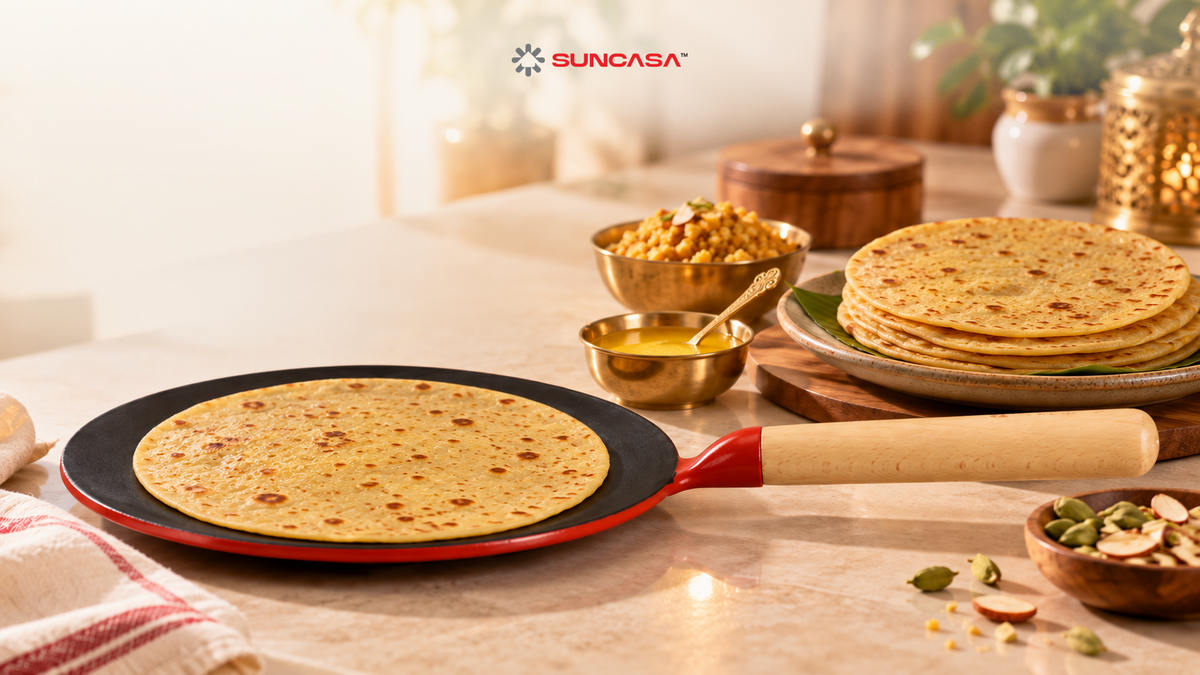
Puran Poli is a much-loved Maharashtrian festive sweet made with a soft flatbread and a fragrant chana dal filling. While the recipe is traditional, the right cookware can make its preparation smoother and more consistent. This authentic Puran Poli recipe, which is made using a cast-iron tawa, combines traditional techniques with dependable cast-iron cooking. Here’s how you can prepare this festive favourite at home with ease.
What Is Puran Poli?
Puran Poli is a sweet stuffed flatbread traditionally prepared with chana dal, sugar or jaggery, and aromatic spices. It is especially popular during Holi and the month of Shravan and is often served with ghee, warm milk, or Katachi Amti.
The recipe has two important elements:
|
Part |
Main Ingredients |
Role |
|
Puran |
Chana dal, sugar, cardamom, nutmeg, saffron |
Sweet filling |
|
Poli |
Wheat flour, maida, oil, salt, and water |
Outer covering |
The key to good Puran Poli is a smooth filling, soft dough, and controlled cooking temperature.
Ingredients for Your Puran Poli
1. Ingredients for Puran
The filling needs only a few ingredients, but each contributes to its familiar flavour and texture.
- 2 bowls chana dal
- 2 bowls sugar
- ½ tsp turmeric
- ½–1 tsp cardamom powder
- A few saffron strands
- ½ tsp nutmeg powder
2. Ingredients for the Dough
- 1 bowl wheat flour
- 1 bowl maida
- A pinch of salt
- Approximately ½ bowl refined oil
- Water, as required
- Rice flour, if needed for rolling
Step by Step Cooking Method
1. How to Make the Puran
Start by washing the chana dal thoroughly. Cook it with approximately one-and-a-half times its quantity of water and turmeric until it becomes soft. Once cooked, strain the dal completely. Keep the strained water aside if you plan to prepare Katachi Amti alongside the Puran Poli.
Next, cook the dal and sugar together in a thick-bottomed kadai over low heat. Keep these points in mind:
- Stir occasionally while the mixture cooks.
- Do not worry if the mixture initially becomes runny after the sugar melts.
- Continue cooking until the excess moisture evaporates.
- A light, powdery sugar film around the edges indicates that the puran is ready.
- Add cardamom, nutmeg, and saffron towards the end.
For a smooth filling, pass the mixture through a traditional Puran yantra while it is still warm. A mixer grinder can also be used. Let the finished puran cool completely before stuffing.
Tip: You can prepare the puran a day ahead and refrigerate it in an airtight container. This makes the final preparation considerably easier.
2. Prepare the Soft Poli Dough
The dough needs to be much softer and more elastic than regular roti dough. This allows it to stretch around the filling without tearing. Mix wheat flour, maida, and salt, then add oil. Gradually add water and knead until the dough becomes soft and pliable.
For better results:
- Knead the dough thoroughly.
- Stretch and fold it repeatedly while kneading.
- Avoid making the dough firm.
- Cover it with a muslin cloth.
- Let it rest for around 30 minutes.
A well-kneaded dough makes stuffing and rolling considerably easier.
3. Stuff and Roll the Poli
Take a small portion of dough and flatten it gently. Prepare a ball of puran that is roughly twice the size of the dough portion. Place the filling in the centre and carefully bring the dough around it. Seal it completely before gently flattening it.
When rolling:
- Use light pressure.
- Spread the filling evenly towards the edges.
- Avoid pressing too hard in one area.
- Use a little rice flour only if the dough begins sticking.
- Keep the finished poli thin but intact.
The dough’s elasticity is particularly important here. Take your time instead of trying to roll it quickly.
Cook Puran Poli on a Cast Iron Tawa
For an authentic Puran Poli Recipe, the cooking surface plays an important role. The SUNCASA CASTELLA Cast Iron Tawa offers a sturdy surface that heats quickly and supports consistent cooking. Place the tawa over low to medium heat and allow it to heat properly. Carefully transfer the rolled poli onto the surface and let it cook before turning it gently.
For even cooking:
- Keep the flame controlled.
- Avoid flipping the poli repeatedly.
- Turn it carefully once the first side is cooked.
- Use a metal spatula if required, as the CASTELLA surface is metal-spatula safe.
- Add only as much ghee or oil as you prefer.
The tawa's quick-heating design helps make cooking efficient, while its naturally non-stick surface allows you to use less oil.
Why Use CASTELLA Cast Iron for Puran Poli?
1. Suncasa Castella Tawa Benefits
The CASTELLA range is designed to combine the cooking performance of cast iron with convenient everyday use.
|
Feature |
Cooking Benefit |
|
Pure iron |
Durable cooking surface |
|
Naturally non-stick |
Helps reduce oil usage |
|
Quick to heat |
Faster cooking |
|
No chemical coating |
Suitable for everyday cooking |
|
Metal spatula safe |
Easy flipping and serving |
|
Exterior enamel coating |
Easier maintenance |
|
Stain and rust-resistant |
Convenient for regular use |
|
Ergonomic wooden handle |
Comfortable handling |
|
Multi-cooktop compatible |
Works on gas, electric, ceramic, induction, and glass |
CASTELLA is also free from PTFE, PFOA, and PFAS. Its design provides a chemical-free cooking surface with zero metal leaching, including during high-heat cooking with acidic foods.
2. CASTELLA Kadhai for Preparing the Puran
The tawa handles the final cooking, while the SUNCASA CASTELLA Cast Iron Kadhai (Preseasoned) can be useful for preparing the dal and sugar filling. Its sturdy construction makes it suitable for cooking the puran over controlled heat. The naturally non-stick surface also helps make stirring and handling the sticky mixture easier.
Tips for Soft and Delicious Puran Poli
Getting the texture right becomes easier when you focus on a few simple details:
- Keep the dough soft: Firm dough can crack while rolling.
- Cool the puran: Hot or loose filling can make stuffing difficult.
- Do not overcook the filling: Very dry puran is harder to spread.
- Roll gently: Too much pressure can cause the filling to escape.
- Control the heat: High heat can brown the poli too quickly.
- Avoid frequent flipping: The stuffed flatbread is delicate.
- Use minimal oil or ghee: The CASTELLA surface is naturally non-stick.
How to Serve Puran Poli
Freshly cooked Puran Poli tastes best while warm. Traditionally, it can be enjoyed with ghee, warm milk, or Katachi Amti. For a festive Maharashtrian meal, serve it alongside savoury dishes and finish with a warm poli topped with ghee. The soft bread, sweet filling, and aromatic spices make it satisfying without requiring complicated accompaniments.
Make Every Festive Meal Special
With the right preparation and cookware, making this festive favourite at home can be simple and enjoyable. This Authentic Puran Poli Recipe brings together soft dough, smooth puran and controlled cooking for a delicious result. Pair traditional techniques with SUNCASA CASTELLA’s naturally non-stick cast iron cookware, and make every festive meal special.
Visit the SUNCASA website store today to explore the cast iron cookware collections.
FAQs
Why is a cast-iron tawa suitable for making Puran Poli?
A cast-iron tawa provides a sturdy cooking surface that heats quickly and supports controlled cooking. The SUNCASA CASTELLA Pre-Seasoned Cast Iron Tawa also has a naturally non-stick surface for easier cooking.
Can I use the SUNCASA CASTELLA Tawa for high-heat cooking?
Yes. The CASTELLA Tawa is designed for everyday cooking and is metal-spatula safe. For Puran Poli, however, controlled low to medium heat is recommended to cook the flatbread evenly without over-browning.
Can the CASTELLA Kadai be used to prepare the Puran filling?
Yes. The SUNCASA CASTELLA Pre-Seasoned Cast Iron Kadai can be used to cook the chana dal and sugar mixture. Its sturdy construction and naturally non-stick surface make stirring the filling more convenient.
How does CASTELLA's naturally non-stick surface help while making Puran Poli?
The naturally non-stick cast-iron surface helps the rolled Puran Poli cook smoothly with less oil or ghee. It also makes flipping and handling the delicate stuffed flatbread easier during cooking.
Is SUNCASA CASTELLA suitable for more than making Puran Poli?
Absolutely. CASTELLA cookware is designed for versatile everyday cooking and is compatible with gas, electric, ceramic, induction, and glass cooktops. Its durable cast-iron construction makes it useful beyond festive recipes.


